
A Step-by-Step Allowance System
I have been thinking about starting an allowance system for my boys for a long time. Especially as a person who cares so much about teaching financial literacy skills, I’ve put this off for too long.
My older son is almost six and my younger one just turned four, and I wasn’t sure how to set it up in a way that made sense to them and was sustainable for me. I wasn't sure they were ready. I wasn't entirely sure I was ready.
What finally got me moving was thinking about it the way I think about my job.
I'm a middle school teacher by day. A significant part of my work is figuring out why something isn't clicking for a kid and redesigning the approach until it does. When a student is having a hard time understanding a new concept, I look at the design. I ask what's missing, what's too abstract, and what needs to be broken into smaller steps before it can make sense. I’ve been doing this for a long time and now it’s just an automatic part of my approach in the classroom.
So I thought that I could try to apply that same thinking to my own kids. What do they actually understand right now? What would make this feel real to them instead of theoretical? What would make it sustainable for me, not just in week one but in week ten?
Here's what I came up with.
Why I'm Starting Now
My boys are preschool and kindergarten age. People sometimes assume that's too young for a formal money system. They can't read a price tag independently. Even if they could, they don't have a clear sense of what things cost and what that means. That’s sort of the point, actually. I want them to understand the value of money and build solid financial habits.
They definitely want to buy things. They notice when other kids have something they don't. My older son desperately wants a Nintendo Switch because a few of his friends have one. Both of my boys understand that money is connected to getting things. And more importantly, they are at an age where new habits can be formed easily and naturally, before money becomes emotionally loaded or tied to a sense of scarcity.
The System: Scaffolded by Design
I’m calling this approach “Quarter by Quarter.” The system is built around actual quarters, and it grows in layers, adding complexity only once the previous layer is solid. This is the kind of scaffolding that I do every day in the classroom–making sure that my students have solid foundational skills before we add something more complex on top.
Tier One: The Base Allowance
In this system, each of my boys receives $2.50 per week with no strings attached. Ten quarters, every week, regardless of behavior or chores. Am I handing out free money? I guess so. The point of this base allowance isn't so much the money itself, but the practice they’ll be able to do. Before they learn to earn money, I want them to understand what to do with it.
The $2.50 amount is super intentional. Ten quarters split cleanly into a 40/40/20 ratio: four quarters to save, four to spend, two to give. Dollar bills are maybe more fun, but they can’t be split up like this. The quarters make it easy and visual, and keep me from having to explain percentages to a preschooler.
Tier Two: Household Contributions
Once they have the base system down, I'll introduce the opportunity to earn additional money by completing daily household tasks. Chores, household contributions, whatever you want to call it–these are the things that all of us do because we live in this house together. I make dinner and daddy does the dishes. One kiddo can set the table and the other can clear it. Things like that. Each of my boys will have their own list, age-appropriate and specific, and completing it earns them an extra quarter per day.
They can earn seven extra quarters each week if they knock out their list every day. If they only do their chores a few times, they’ll only get a few extra quarters. The system resets each day, rather than a weekly check in to see if they did everything or not. At four and six, they need an immediate reward and a little extra grace for the tough days.
Tier Three: The Earning Menu
Eventually, I think I’ll develop a list of optional tasks that’ll be worth a fixed amount. Washing the baseboards, cleaning out the car, or maybe, pulling weeds. They can look at the list, decide if something is worth their time, do the work, and get paid. This is where they’ll start to develop some agency and autonomy as they earn more money for the things they want.
The Jars
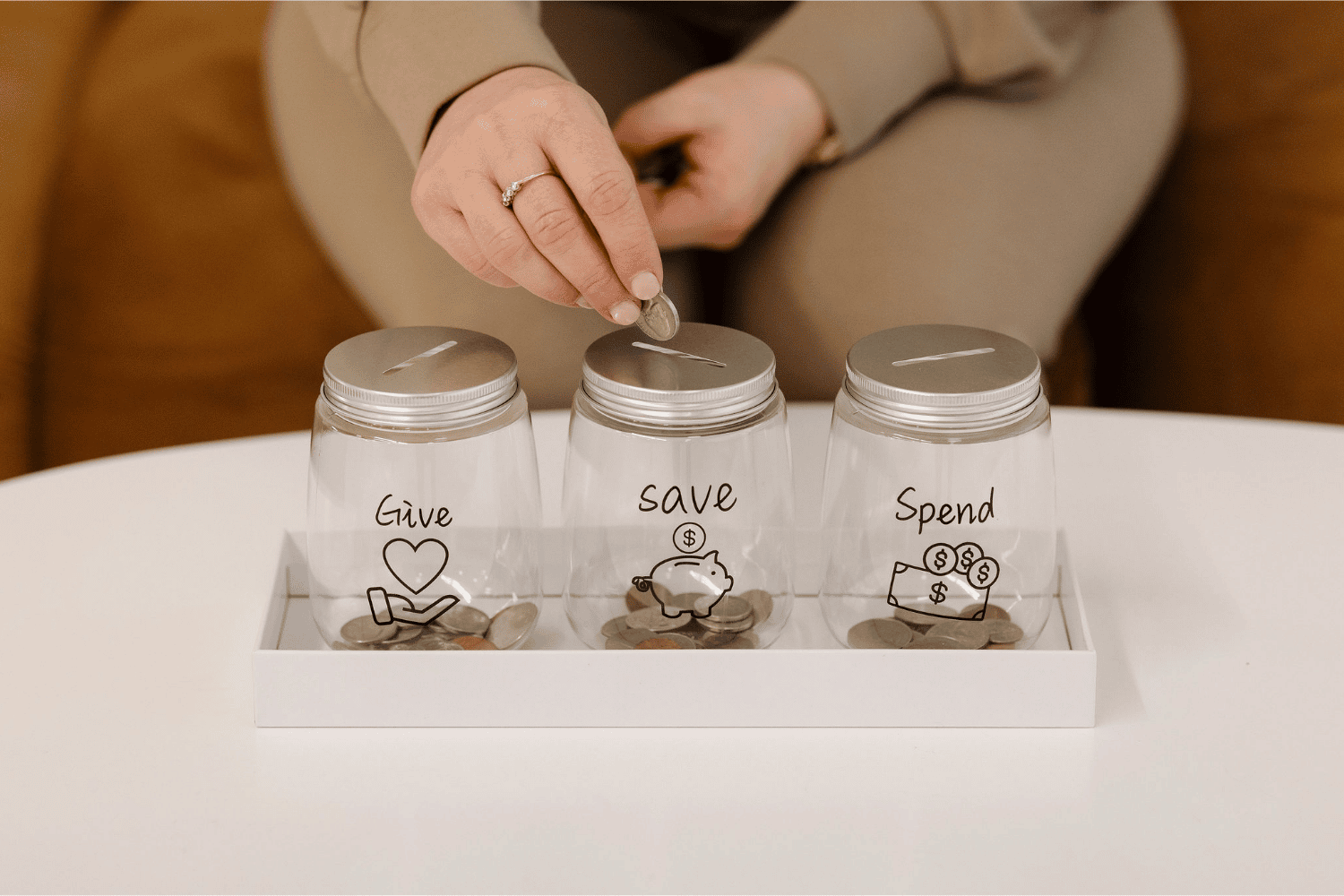
Both boys have three jars: save, spend, and give. I created the labels myself (very on brand for me), and the boys decorated them before we stuck them on. When kids have a hand in creating something, they're more invested in using it.
On allowance day, they count out their own quarters. Ten quarters, sorted into three jars. I’m hoping that the tangible aspects of hearing the coins drop, watching the jars fill up, and holding the money in their hands before it goes anywhere, makes the concepts stick a little easier.
They’ll grow the money in their save jar over time and will work toward a specific goal. Right now, I'm coaching them gently toward what they're saving for, and we'll formalize that more as the system matures.
The money in the spend jar is essentially theirs to use as they choose–within reason, at least. I want them to feel the satisfaction of spending money they saved up, and also the occasional sting of spending it on something that wasn't worth it.
The give jar allows them to contribute to our community. Kids this age understand generosity more easily than I would have thought. My boys have already participated in giving through holiday donations at home and at school, and by creating “birthday in a bag” kits for a local foster agency. When their give jar has enough money, they'll get to choose where it goes.
The fourth jar, invest, is coming later on. Obviously, I've already printed the sticker. But I want them to master the save, spend, and give concepts before I introduce the complexities of investing.
I'm also thinking about adding a simple paper tracker beside their jars so they can see the running total. At four and six, watching a number grow is genuinely motivating. It's the same reason I had a chart on our refrigerator when my husband and I were paying off his student loans: the visual progress made the abstract feel real.
What Comes After This
The system I'm starting with is the simplest version that I think will actually work. Over time, the tiers will expand and the conversations will get more sophisticated. At some point we'll talk about a real bank account, a debit card with training wheels, and the basics of investing in terms they can grasp.
But we're starting with ten quarters and three jars. I’ve got two kids who are very excited about the whole thing, but who don’t quite understand the process yet. That’s fine, and that’s why we’re starting so simple.
Check back soon for an update on how this is unfolding. I’ll share the good weeks and the weeks where I just plain forget to give them their quarters. I don’t think the system has to be perfect–it just has to meet my kids where they’re at right now.
Alaina Trivax is a certified teacher, financial writer, and founder of Let's Make it Grow — a resource for parents who want to raise financially confident kids. Her book, Follow the Money, publishes August 4, 2026 with Penguin Random House.
